In this article
What Kirchberg actually is
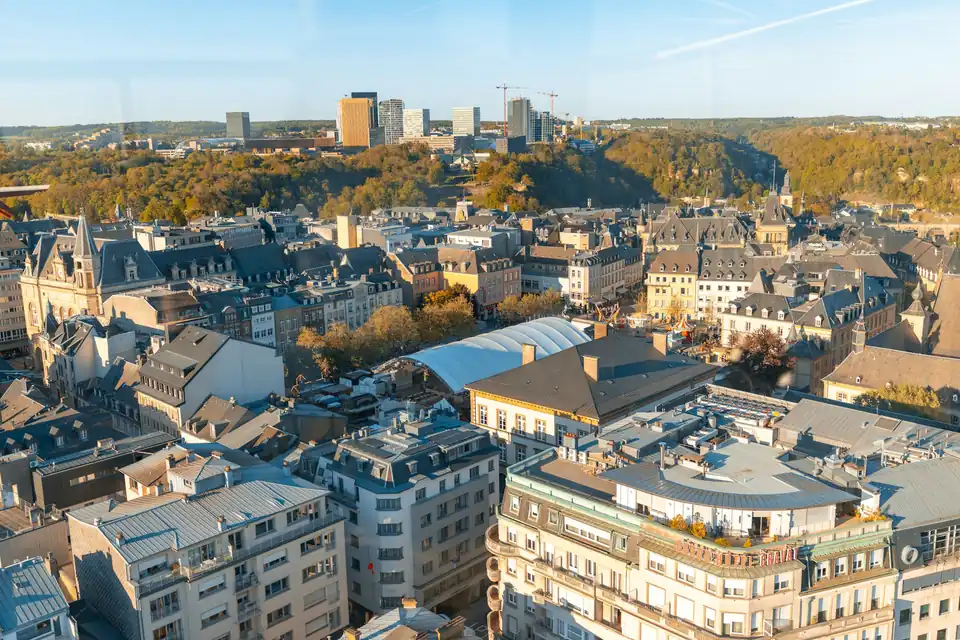
Kirchberg is a plateau north-east of the historic centre, separated from it by the Alzette valley and connected by the Grand Duchess Charlotte Bridge, the red steel structure that appears in most photographs of modern Luxembourg. Until the 1960s it was farmland. Everything on it today was planned.
That planning is the defining fact. Kirchberg is not a quarter that grew street by street over two centuries, like Bonnevoie or Grund. It was laid out as a European district: wide avenues, generous setbacks, institutional buildings with space around them, and a road network designed for volume. Avenue John F. Kennedy runs its length and functions as its spine.
The result is a place with a very distinct texture. It is clean, modern, green in a deliberate way, and organised. It is also, by European standards, unusually low-density for somewhere with this much economic activity.
Who works there
The concentration is remarkable for a plateau this size. The European Court of Justice, the European Investment Bank, the secretariat of the European Parliament and a range of other European bodies sit here, alongside a substantial share of Luxembourg's banking and fund administration sector.
For anyone arriving to work at one of these institutions, Kirchberg is the destination. The practical question is whether it should also be the address, and the answer is less obvious than it looks.
Transport
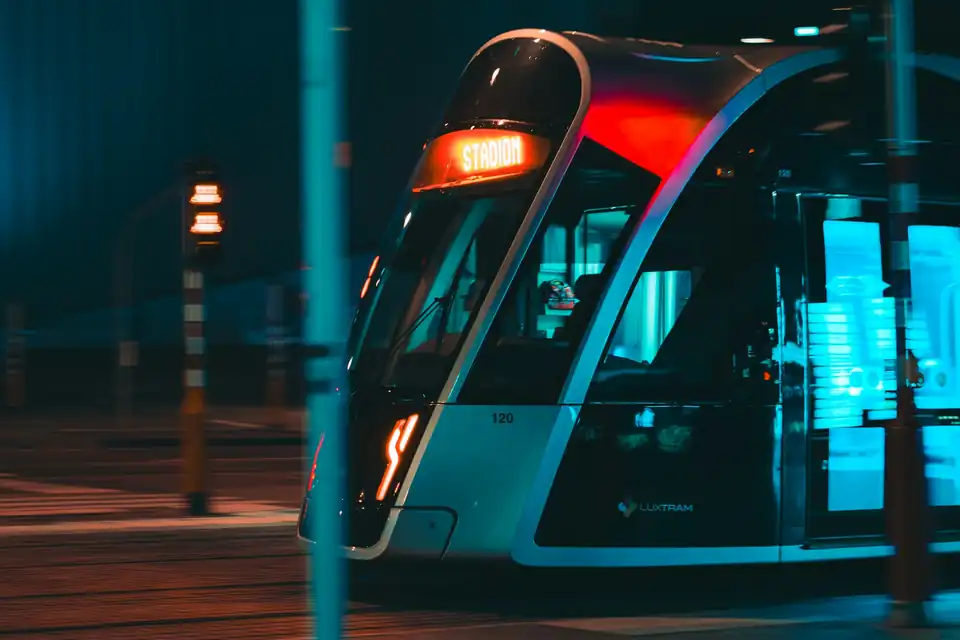
Kirchberg is the best-connected part of the country. The tram runs its full length, from the Luxexpo and airport end through the plateau, across the bridge to Place de l'Étoile in Limpertsberg, through Ville Haute, down Avenue de la Liberté to the Central Station, and onward to Bonnevoie, Howald and Cloche d'Or.
The Pfaffenthal-Kirchberg railway station sits below the plateau and is connected to it by a funicular, which puts national and cross-border rail within a few minutes of the office. Since March 2025 the tram also reaches the airport directly.
All of it is free. This matters more than it first appears, because it means the transport advantage of living in Kirchberg over living twelve minutes away on the same tram line is a matter of time only, not money. Twelve minutes is not much of an advantage.
The single most useful thing we tell people who accept a job in Kirchberg: check the tram journey time from three or four other quarters before assuming you need to live on the plateau. Most are surprised.
What living there is like
Kirchberg has a genuine residential population, concentrated in the Weimershof and Kiem areas and in newer apartment developments along and behind the main avenues. The housing stock is overwhelmingly modern, generally well built, and often comes with the amenities that older city buildings lack: lifts, parking, insulation, proper storage.
The trade-off is atmosphere. Kirchberg empties in the evening. The streets that carry thousands of people at nine in the morning are quiet at eight at night, and the quarter has comparatively few of the small bars, corner restaurants and neighbourhood shops that give the older quarters their evening life. What it has instead is a large shopping centre, a cinema complex and a set of institutional restaurants that follow office hours.
Some people find this restful. Others find it institutional. Both reactions are common and neither is wrong; the important thing is knowing which one you will have before you sign a lease.
Culture, sport and green space
This is where Kirchberg is genuinely strong, and where the planning pays off.
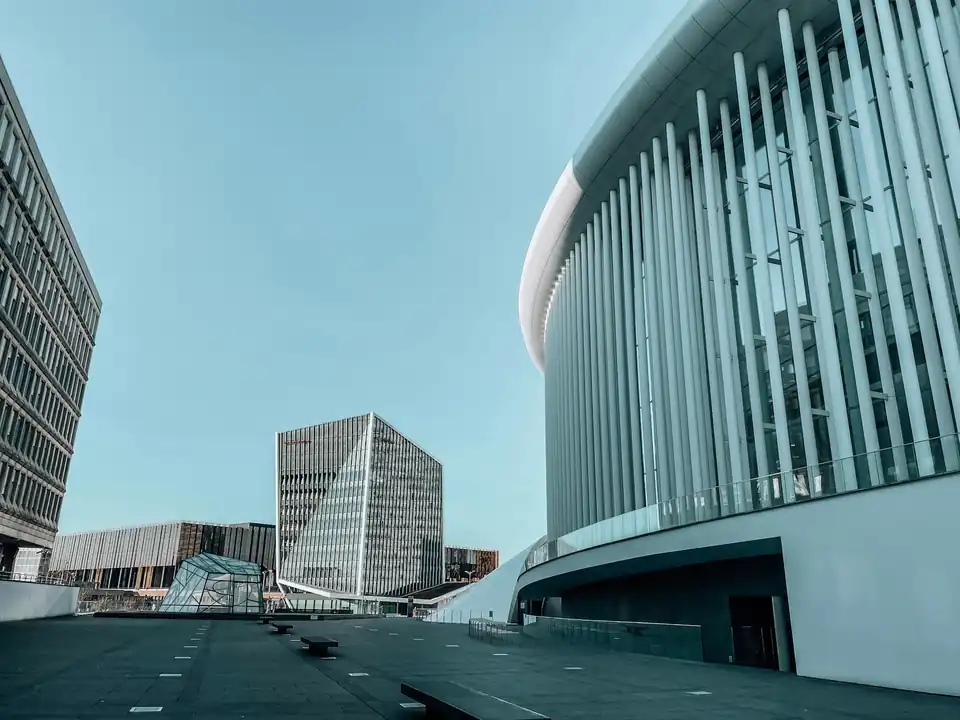
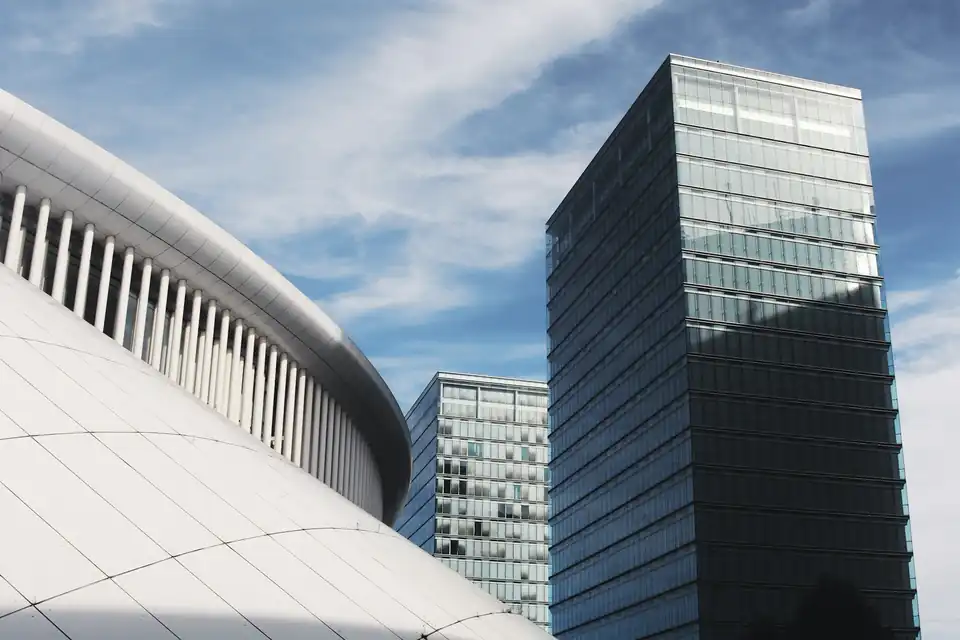
The Philharmonie Luxembourg is one of the best concert halls in Europe and sits on Place de l'Europe. MUDAM, the museum of modern art housed in a building by I. M. Pei, is a few steps away. The Coque national sports and cultural centre provides a swimming and sports complex of a standard most cities of this size do not have. Luxexpo hosts the country's trade fairs and large events.
Green space was designed in rather than left over. The plateau has substantial parkland threaded through it, and the drop into the Alzette valley on either side gives access to walking routes that feel considerably further from an office district than they are.
For families, Kirchberg's institutional density brings international schooling and childcare provision into easy reach, which is one of the more concrete reasons households with children choose the plateau over the older quarters.
Who it suits, and who it does not
It suits
- Families who value space, modern buildings and proximity to international schooling. This is the strongest case for Kirchberg and the reason its residential population skews the way it does.
- People who genuinely want quiet. Kirchberg at night is calm in a way central quarters are not.
- Anyone who travels constantly. Airport on the tram, rail below the plateau.
- People who use the cultural and sports infrastructure. If you swim four times a week or attend concerts monthly, living beside them is worth something real.
It suits less well
- People arriving alone on a first posting. Kirchberg is not where you meet people incidentally, and the room rental market here is thin compared with the older quarters.
- Anyone who wants to walk out of the door into a neighbourhood. Kirchberg is walkable but not strollable; the distances between things are planned distances.
- Budget-sensitive renters. Modern stock in a prime employment district is priced accordingly.
The five-minute alternatives
Because the tram is fast and free, the quarters within a short ride of Kirchberg deserve serious consideration, and they are the ones we most often place people in.
Limpertsberg sits across the bridge at Place de l'Étoile, elegant and genuinely residential, with a tram stop connecting directly to both Kirchberg and the centre. It is the classic answer for someone who works on the plateau but wants a neighbourhood to live in.
Neudorf lies directly below Kirchberg in the Alzette valley, with an older village character and a very short journey up to the plateau. Prices are noticeably more accessible.
Weimerskirch and Dommeldange continue north and offer more space for the money, with Dommeldange holding its own railway station.
Bonnevoie, at the other end of the tram line, trades a longer ride for a considerably livelier quarter and better value. For a single professional on a first contract, this is frequently the better deal.
The rental picture
Kirchberg sits at the upper end of the Luxembourg City rental range. According to the asking-rent series published by the Observatoire de l'Habitat, the ministry's housing observatory, Kirchberg is consistently among the highest per-square-metre quarters in the capital, alongside Limpertsberg and Belair. Those figures are asking rents drawn from advertisements rather than rents actually signed, so treat them as an upper bound rather than a market price.
What Kirchberg has comparatively little of is shared accommodation. The stock is dominated by whole apartments aimed at families and dual-income households, which means someone looking for a single furnished room will find far more options a few tram stops away.
Our own rooms are concentrated in Limpertsberg, Bonnevoie and Rollingergrund, precisely because that is where the shared-apartment market is, and all three are within a straightforward commute of the plateau. Current availability is on our rentals page, and the Kirchberg quarter page covers the transport detail.
Our take
Kirchberg is an outstanding place to work and a good place to live for a specific kind of household: families, people who value modern buildings and quiet, and anyone who uses the cultural and sports infrastructure regularly. It is a weaker choice for someone arriving alone who wants a neighbourhood, a social life within walking distance and a room rather than an apartment.
The free tram makes this a genuinely open choice rather than a constrained one. Work on the plateau, live where the quarter suits you, and let the twelve minutes do the rest. If you want help comparing the actual commute from two or three quarters against your office address, ask us.