In this article
The route, stop by stop
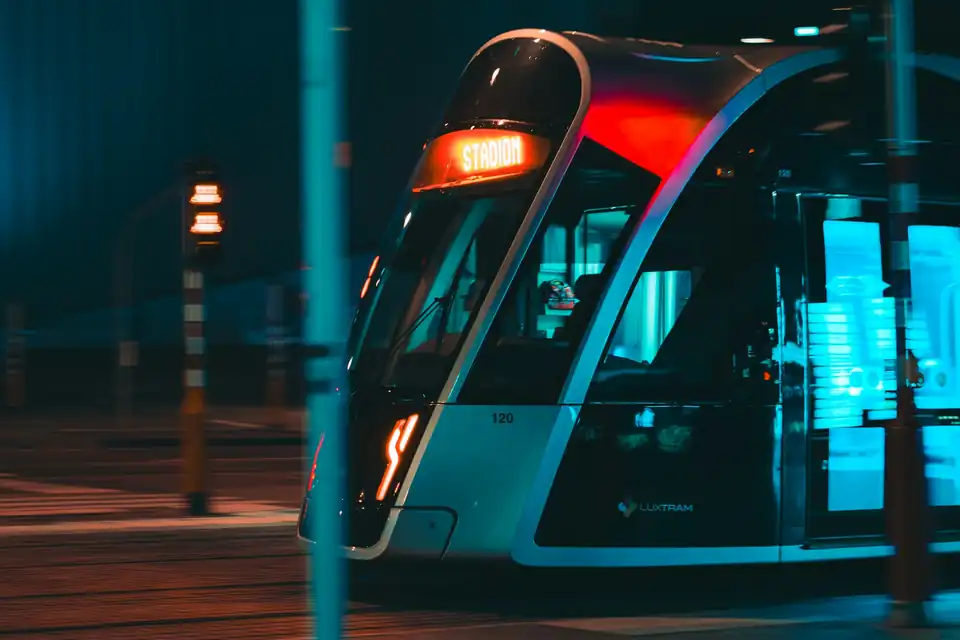
Operated by Luxtram S.A., a public company set up by the State and the City of Luxembourg, the T1 line runs in a continuous corridor with 24 stops, according to the City's own transport pages. From north-east to south-west, it links:
- Findel, Luxembourg Airport and the Héienhaff park-and-ride, at the northern end;
- Luxexpo The Box and the university and library area on the Kirchberg plateau;
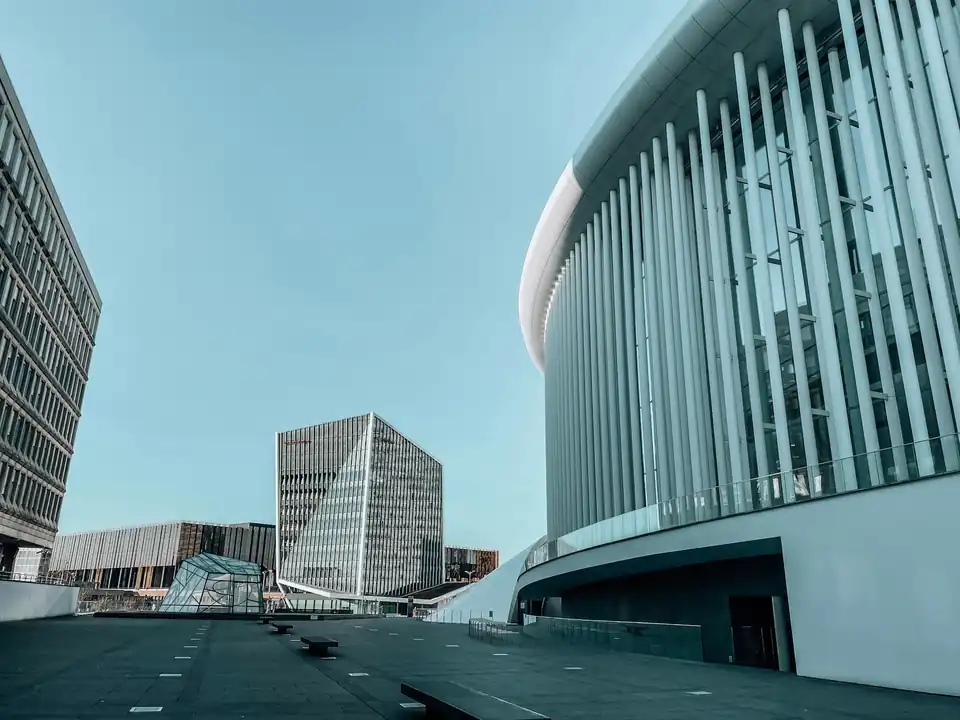
- d'Coque, the European Parliament, the Philharmonie and MUDAM;
- Rout Bréck-Pafendall-Kirchberg, where the Pfaffenthal funicular connects down to the valley railway station;
- Théâtre, Faïencerie and Stäreplaz/Étoile, along the edge of Limpertsberg;
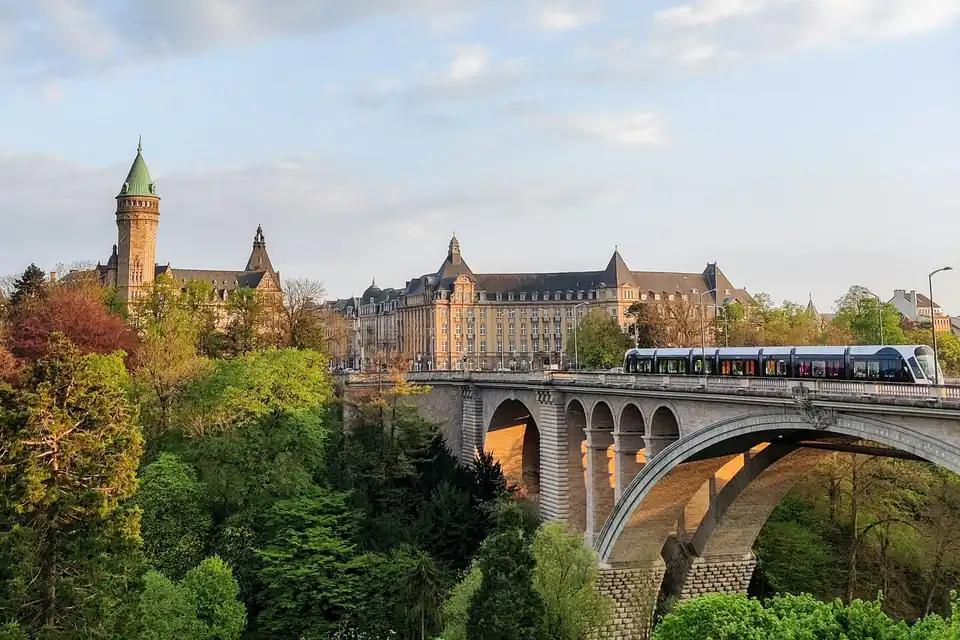
- Hamilius, in the heart of the old town;
- Place de Metz, Paräisser Plaz and Gare Centrale, the central railway station;
- through Bonnevoie towards Howald and on to Cloche d'Or and the Stadion, the national stadium.
The airport extension opened in 2025 and the southern extension to Cloche d'Or and the Stade in 2024, so the line as it exists today, end to end, is recent. Further extensions beyond the current termini have been discussed but nothing is confirmed as this is written; check Luxtram's own announcements for the latest.
Frequency and free travel
According to Luxtram, trams run every 3 to 8 minutes on the busiest sections, with a stated capacity of up to 10,000 people per hour in each direction, which puts it well beyond what any city bus line can offer. As with all public transport in Luxembourg since 29 February 2020, travel on the tram is free, in second class and without a ticket, card or registration; our guide to free public transport covers the detail and the rare exceptions.
In practice, that combination of frequency and cost means residents near a stop simply walk out and board, rather than planning around a timetable, at least during the day. Early mornings, late evenings and weekends are less frequent, so it is worth checking the current schedule through the Luxtram app if your routine depends on the edges of the day.
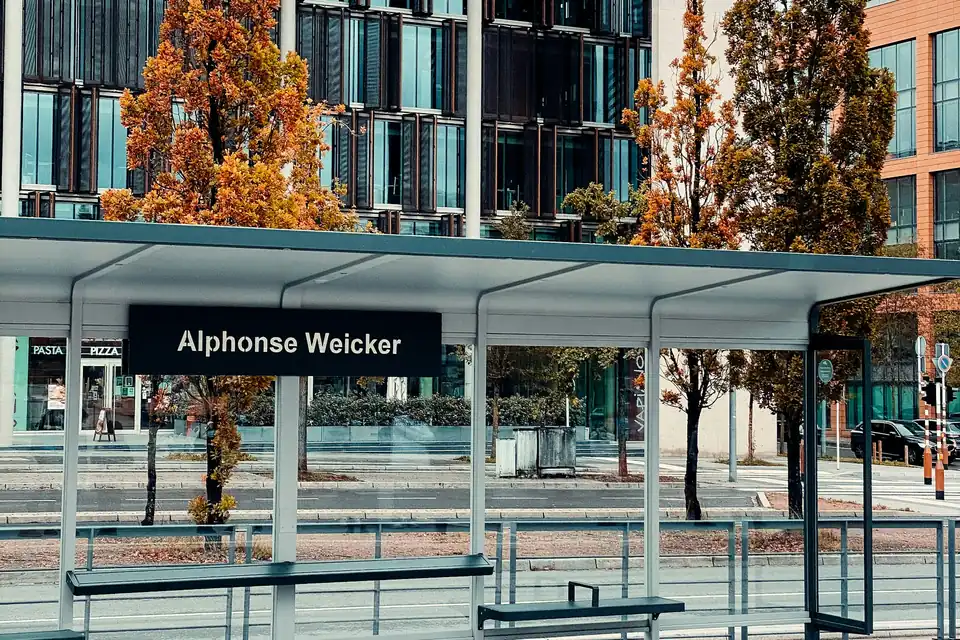
Which quarters the tram actually serves
The line does not touch every quarter, and that matters more than its total length suggests.
Directly on the line: Kirchberg, the northern edge of Limpertsberg (Stäreplaz), the old town (Hamilius), the Gare quarter, Bonnevoie, and Cloche d'Or/Gasperich (via Howald). Our guides to Kirchberg, Limpertsberg, Bonnevoie and Gasperich and Cloche d'Or go into each quarter's character in more depth.
Close, via the funicular: Pfaffenthal, where the funicular from Rout Bréck-Pafendall-Kirchberg connects the valley railway station directly to the plateau tram in under two minutes. Our guide to the valley quarters explains how residents use this connection daily.
Not on the line: Belair, Merl, Hollerich, the Grund, Clausen, Rollingergrund and the northern valley quarters (Eich, Weimerskirch, Dommeldange, Beggen) rely on buses to reach the tram or the station, and journey times vary a great deal depending on the exact line and time of day.
What living near a stop actually changes
For someone weighing two similar flats, one five minutes from a tram stop and one fifteen minutes from the nearest bus stop, the difference goes beyond convenience.
- Commute reliability. A tram every few minutes removes the anxiety of missing a bus and waiting twenty minutes for the next.
- Reach without a car. The line already connects the airport, the two main employment plateaux (Kirchberg and the centre), the station and the southern business district in one uninterrupted corridor, so a household without a car can genuinely function.
- Evening and weekend options. Reaching the Philharmonie, MUDAM, the old town's restaurants or the Cloche d'Or shopping centre without driving or waiting for an infrequent bus changes how often people actually go.
- Price. Proximity to a stop is increasingly priced into rents and sale prices, particularly in newer Kirchberg and Cloche d'Or developments built with the tram in mind.
Our guide to living without a car sets out which quarters make that choice realistic, and the tram corridor is the backbone of nearly all of them.
The trade-offs to weigh
Living directly on the tram line is not free of downsides. Stops along Avenue John F. Kennedy in Kirchberg and around Hamilius sit on busy, office-lined streets that are quiet on weekend evenings but can feel impersonal outside working hours. A flat facing the line itself may pick up some street noise, generally modest for a modern tram but worth checking at a viewing, ideally at different times of day. And because the line has grown quickly, several stretches, particularly around Kirchberg and Cloche d'Or, still sit next to active construction sites; ask what is planned on an empty plot before signing.
Getting to and along the tram if you live elsewhere
Many quarters not directly served still connect well through a short, direct bus line to the nearest stop. Before ruling out a flat in Belair, Merl or one of the northern valley quarters, check the actual bus frequency and journey time to the nearest tram stop at the time you would be travelling, rather than assuming a map distance tells the whole story.
The city's bus network, AVL, was reorganised in February 2026, according to the City of Luxembourg, and several routes and stops changed as a result. If you last checked bus connections before that date, it is worth checking again on the current AVL map rather than relying on an older guide, since a route that used to reach a tram stop directly may now follow a different path.
Cycling and the tram together
For anyone weighing a bike over a bus for the last stretch to a tram stop, the city's electric bike-share system, vel'OH!, has stations clustered around most major tram stops, including Hamilius, the station and several points along Kirchberg. Combining a short ride with the tram is often faster door to door than waiting for a connecting bus, particularly outside peak hours. Our guide to cycling in Luxembourg City covers how the network fits together with public transport.
Our take
The tram has changed which quarters make sense for a car-free household in Luxembourg City, and it is now one of the first questions we ask a tenant or buyer: do you want to be on the line, five minutes from it, or is a good bus connection enough for you? Kirchberg, Bonnevoie, the Gare quarter and Cloche d'Or offer the most direct access; Limpertsberg and Pfaffenthal offer it at the edge with real character in exchange. See our current listings filtered by quarter, or contact us and tell us your daily route so we can point you to homes that actually shorten it.