In this article
Vel'OH!, the city's bike-sharing system
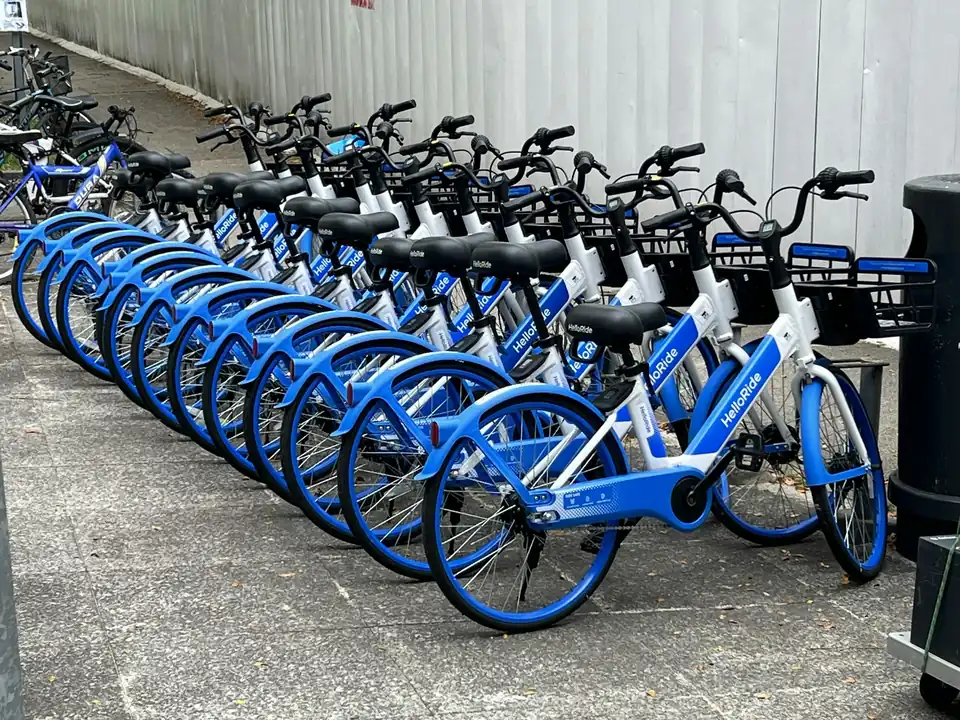
Vel'OH! is Luxembourg City's public bike-sharing service, run for the city by JCDecaux, and it now operates with electric pedal-assist bikes at more than 100 stations across the city and neighbouring communes such as Strassen, Bertrange, Niederanven and Leudelange. According to the operator, the assistance activates through pedal torque and phases out near 25 km/h, which takes the sting out of the city's steeper climbs, for example the long haul out of the Pétrusse or Alzette valleys towards the plateaus.
The bikes have front and rear lights, a chainguard, and multi-function handlebars that let you undock a bike with a contactless bank card as well as the app. The service runs 24 hours a day, seven days a week, and customer support is available by phone in the daytime and early evening.
Subscriptions and casual use
Vel'OH! offers several ways to pay: an annual subscription for regular users, and short-term passes for visitors or occasional riders, priced by the day (a one-day pass and a three-day pass are both available at low cost). Employers can also arrange group or business plans for staff. Because prices and the free-ride threshold for the first minutes of each trip are adjusted from time to time, check the current tariffs and sign-up process on the official vel'OH! site or the subscriber portal before committing to a plan.
Vel'OH! is designed for short hops between stations, not for keeping a bike overnight. If you plan to cycle regularly and want a bike parked at home, buying or renting your own (including at a subsidised rate, see below) usually works out cheaper.
The cycle lane network
Luxembourg City has been extending its cycle path network steadily, with dedicated lanes along several of the main valley routes, including sections along the Pétrusse and Alzette, and connections up towards Kirchberg and the Gare quarter. Coverage is uneven: some arterial roads in the centre still mix cyclists with traffic, while newer developments, notably around Kirchberg and Cloche d'Or, have been built with cycling infrastructure from the outset. The PC15 and PC16 long-distance cycle paths (Piste Cyclable) network, maintained nationally, connects the city to surrounding communes and further afield, useful for commuters living just outside the centre.
If you are choosing a home partly around cycling, look at the actual route to work or the crèche, not just the straight-line distance. A flat 3 km ride along a valley path can be quicker and more pleasant than a hillier 1.5 km route through traffic. Our guide to living without a car covers how cycling fits alongside the tram and bus network for people who do not want to drive at all.
Hills, valleys and the lifts
The city's geography is its main cycling challenge. Luxembourg City sits across several plateaus separated by the Alzette and Pétrusse valleys, so many direct routes involve a steep climb or descent. The city's free public lifts and the Pfaffenthal funicular (linking the Grund and Kirchberg via the Pont Rouge) help pedestrians and cyclists avoid the worst gradients, though not all lifts are large enough for bikes with panniers. If your daily route crosses a valley, an e-bike or a vel'OH! with pedal assist removes most of the difficulty; a standard bike without assistance is a harder proposition for a regular commute here.
Bikes on the tram and train
Combining cycling with public transport is common in Luxembourg, and the rules are straightforward within the country.
On CFL trains, bikes travel free on domestic routes and do not need a reservation, according to CFL. Space is limited and offered on a first-come basis, so avoid rush hour (roughly 6:00 to 9:00 and 16:00 to 19:00) if you are travelling with a bike, and load and unload it yourself promptly so you do not block doors. Cross-border trips into Belgium, France or Germany can require a bike ticket or reservation, so check with CFL before an international journey with your own bike; folding bikes stowed as luggage are generally treated differently from full-size bikes, so ask if in doubt.
On the tram, capacity for bikes is limited compared with the train, and vel'OH! bikes cannot be taken onto the tram or train at all since they are shared, dockable bikes meant to stay within the network. For a mixed commute, the practical pattern is either to cycle the whole way, or to park a personal bike at a station and take the train or tram the rest of the distance.
Buying a bike, and subsidies
Luxembourg has, at various points, offered subsidies for the purchase of bicycles and electric bikes as part of its mobility strategy (the Clever Vëlo or Klimabank-style incentives have taken different forms over the years). Because eligibility, amounts and whether the scheme is even open change from year to year, check the current status directly on mobiliteit.lu or guichet.lu before assuming a subsidy is available; do not budget around one until you have confirmed it in writing.
Bike shops in the city and nearby communes sell and service both standard and electric bikes, and several offer maintenance contracts, useful given how much salt and grit are used on hilly streets in winter.
Parking your bike
Secured bike parking, including the covered mBox lockers found at some stations and public spots, gives more protection than a street rack, particularly for an e-bike with an expensive battery. Availability of mBox spaces is limited in the busiest quarters, so if secure parking is a priority for your daily commute, check what is available near your building before signing a lease, and ask the landlord whether the building itself has cellar or courtyard space for bikes, since older buildings in Ville Haute and Bonnevoie were not built with bike storage in mind.
Safety on the road
Luxembourg drivers are generally used to cyclists, but narrow historic streets in Ville Haute, Grund and Clausen, cobblestones, and tram tracks near Hamilius and the Gare all call for care. Lights are legally required after dark, and a helmet, while not compulsory for adults, is strongly advisable given the hills and the mix of cobbles and tram rails. Cyclists share some pedestrian zones in the old town at restricted hours; look for signage rather than assuming access.
Our take
Cycling works well in Luxembourg City for anyone willing to use the electric assistance that vel'OH! and most modern e-bikes now offer, and it pairs naturally with the tram and train for longer trips. If you are choosing where to live and cycling matters to you, we can flag which of our current listings sit on a flat, well-served route rather than at the top of an unassisted climb, and our neighbourhood guides note cycle access where it is genuinely good, not just theoretically present.
Sources
This article gives general practical information. Services, prices and rules change; check the current details with the operator or the commune concerned.