In this article
A parking space is usually its own lot
In a Luxembourg copropriété (co-ownership), an underground or covered parking space is typically recorded as its own distinct lot, with its own share of the co-ownership's quote-parts (the fraction used to calculate your share of common charges), separate from the lot representing the flat itself. This has a practical consequence: a parking space can generally be bought, sold or rented independently of the flat, even though in practice most buyers acquire both together in a single transaction.
Because it is a separate lot, buying a parking space involves the same basic mechanics as buying the flat: it appears as a distinct item in the compromis de vente and the notarial deed, with its own description and its own share of the price. If you are buying a flat and a parking space together, check that both are clearly itemised, since the split between the two can matter for other purposes, such as calculating registration duties or, for a rental investment, apportioning the price for tax purposes.
Registration duties and the Bëllegen Akt
The registration and transcription duties (6% plus 1%, as described in our guide to the Bëllegen Akt and registration duties) apply to the full price paid, including any parking space or cellar sold alongside the home. The Bëllegen Akt tax credit, which reduces or eliminates these duties up to a ceiling per buyer, applies to a main residence purchase as a whole; a parking space bought at the same time, as part of the same transaction, generally benefits from the same treatment as an accessory to the main residence. A parking space bought separately, later and on its own, is a different transaction and should be checked individually with the notary rather than assumed to carry the same benefit automatically.
Buying a garage or space without buying a flat
It is possible to own a parking space in a building without owning a flat there at all, for example as a pure investment, or because you live nearby and want secure parking. The same co-ownership rules apply: you become a co-owner for that lot alone, pay a share of the common charges proportional to your quote-parts, and can rent the space out or sell it independently, subject to whatever restrictions the co-ownership's rules (règlement de copropriété) impose, such as a requirement that a sale or lease be limited to another resident of the building or the immediate area. Read the règlement de copropriété before buying a standalone space, since some buildings restrict who a parking lot can be sold or let to.
The resident's parking vignette in Luxembourg City
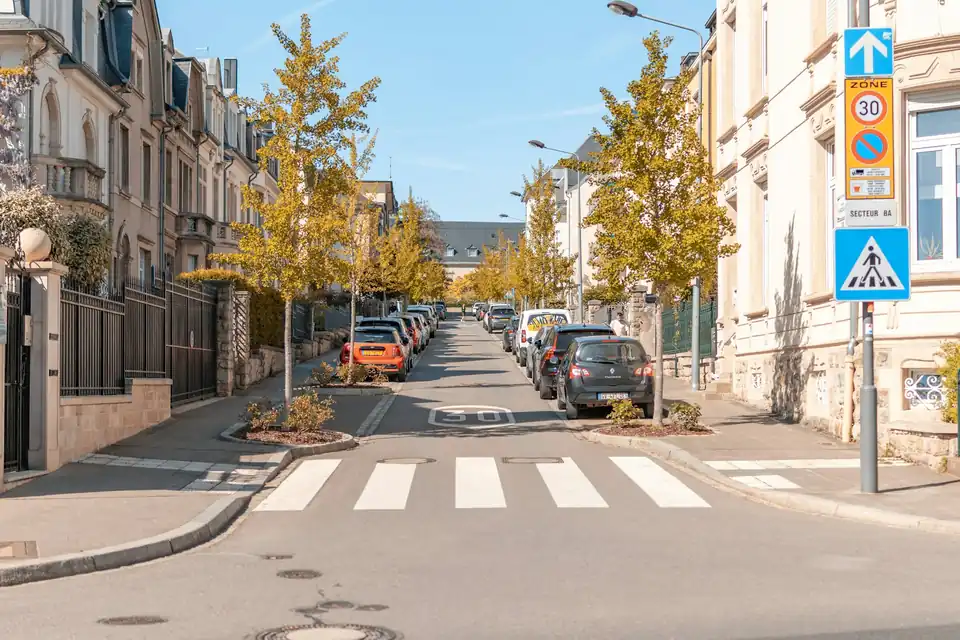
If your home does not come with a dedicated space and you plan to keep a car, the Ville de Luxembourg's residential parking permit (vignette de stationnement résidentiel) is the main alternative, though it is a permit to park in a public street zone, not a guaranteed or reserved space. As of the current rules published by the city:
- The city is divided into parking sectors (around two dozen zones), each identified by a short code, and a permit is valid only within its own sector.
- A resident can generally hold up to three vignettes, with the first free of charge and subsequent ones priced progressively higher.
- Separate, lower-cost visitor permits are available for guests, limited to a maximum number of days per year.
- Applications are made online through the city's portal, with a vehicle registration document required.
A resident's vignette lets you park within your zone but does not reserve a specific spot, and availability on the street varies considerably by quarter and time of day. For a household with two cars, or for anyone who values certainty over cost, an owned or rented off-street space remains the more predictable option. Check the current fees and zone map on vdl.lu before budgeting, since sector boundaries and prices are reviewed periodically.
What a dedicated space is worth
A private, secure parking space measurably affects both the asking price and the resale speed of a flat in Luxembourg City, more so than in many other capitals, precisely because street parking is constrained and increasingly regulated. Buyers weighing two otherwise similar flats will often pay a real premium for the one with underground parking included, and agents report that flats without any parking take longer to sell or rent in quarters where street parking is tight. If you are pricing a purchase or a sale, our guide to how property is valued covers this alongside the other factors that move a price beyond raw square metres.
Cellars: the other separate lot
Alongside a parking space, most Luxembourg flats in an apartment building come with a cellar (cave), also typically recorded as its own lot or as an annex to the main lot, and excluded from the living area calculation under the ILNAS standard (see our guide to how surface area is measured). A cellar's size and accessibility (a walk-in room versus a wire-mesh cage) vary considerably between buildings and are worth checking at a viewing rather than assumed from the listing description, since "cellar included" can mean very different things in practice.
Questions to ask before buying a space
- Is the space recorded as its own lot, with its own quote-parts, or as a fixed annex to the flat that cannot be sold separately?
- What is the annual charge attributable to that lot specifically?
- Does the space fit your actual vehicle? Older buildings sometimes have narrower spaces or lower clearances than modern SUVs and estate cars require.
- Is there a lift or ramp access, and is it wide enough for your car?
- Does the règlement de copropriété restrict who the space can be sold or let to?
Our take
In a city where street parking is genuinely scarce in several quarters, a private space is not a minor extra, it is a factor that shapes both your daily life and your property's resale value. If a flat you like does not come with one, check whether a separate space in the same building is available before assuming the residents' vignette will be enough for your needs, particularly if you own more than one car. Browse our current listings filtered by parking availability, or contact us if you would like help finding a flat with the parking situation sorted from the outset.
Sources
This article describes general rules and market practice in Luxembourg and is not legal, tax or financial advice. Rules and announced measures change; confirm the position that applies to you with a notary, your bank or a tax adviser before signing.