In this article
Why look beyond the city at all
Luxembourg City is only one of 100 communes in the country, and it covers a small area relative to the built-up region around it. Several neighbouring communes have grown into de facto extensions of the capital, with their own supermarkets, schools and business parks, while staying inside Luxembourg rather than crossing into France, Belgium or Germany. That distinction matters: living in these communes keeps you inside the Luxembourg tax and social security system, avoids the cross-border commute questions covered in our guide to living in the city or across the border, and usually means a shorter, more reliable journey than commuting from Thionville or Arlon.
Strassen
Strassen sits immediately west of the city, bordering Belair and Bertrange, and has become one of the most sought-after and expensive communes outside the capital: according to the national statistics office, it ranked as the third most expensive commune in Luxembourg with average prices around €9,800 per square metre for existing homes in mid-2024. Its population has roughly doubled since 2000, now around 10,600 residents, and density is among the highest of any Luxembourg commune outside the city itself.
The draw is straightforward: fast hybrid-bus links into the city centre, a well-used aquatic centre (Les Thermes), and a mix of apartment blocks and older houses. It suits people who want city-adjacent convenience without a city postcode.
Bertrange
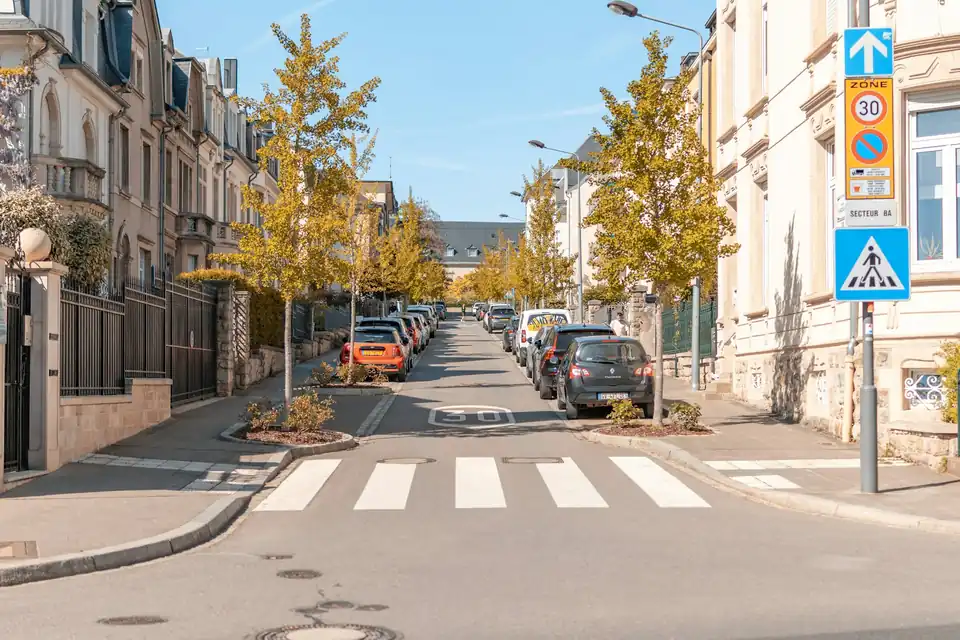
Bertrange lies about 6.5 km west of the city and is best known locally for hosting La Belle Étoile, Luxembourg's largest shopping centre, in its Tossenberg district. With around 9,100 residents from more than 100 nationalities, it is one of the country's most international communes outside the capital. Housing is a mix of detached houses, terraced homes and newer apartments, generally at a small discount to equivalent city quarters like Belair or Merl, which it borders.
Hesperange and Howald
Hesperange is one of the larger communes by population (around 17,000 residents in 2025, with 54% foreign nationals) and stretches from the doorstep of Gasperich and Cloche d'Or down the Alzette valley. It is really five distinct places: Hesperange itself, Howald, Alzingen, Itzig and Fentange. Howald is the most urban of the five, directly abutting the city, served by both a CFL train station and the T1 tram extension towards the airport, and increasingly built up with offices and apartments along Rue des Scillas. The other localities are quieter and more residential. Average sale prices here run below the city's own averages, and the commune has been investing in school and after-school-care capacity to keep pace with growth.
Walferdange
North of the city in the Alzette valley, Walferdange (around 8,900 residents) has a CFL railway station on Line 10 and frequent bus links, plus the N7 road. It has a more established, small-town feel than the western communes, with a Roman villa site, a former royal castle now used by the university, and the PIDAL swimming and spa complex shared with neighbouring communes. It suits people who want a quieter, greener setting within a short train ride of the Kirchberg and city-centre job clusters.
Sandweiler
Sandweiler, about 5 km east of the city, is small (under 4,000 residents) and dominated by its neighbour: Luxembourg Findel Airport straddles the boundary between Sandweiler and Niederanven, and Luxair and Cargolux both have their head offices here. Surrounded by forest, it is a practical, low-key option for people who work at or near the airport, though aircraft noise is a real factor to check at any viewing, as discussed in our guide to the quietest quarters.
Niederanven
Niederanven, just north-east of the city, includes Senningerberg, Senningen, Oberanven and several smaller villages, and is consistently ranked among the wealthiest communes in the country by income. It sits at the junction of the A1 motorway and the N1, close to the airport and to European institution sites at Senningerberg. Housing here tends towards detached and semi-detached family homes rather than apartments.
Mamer
Mamer, about 7 km west of the city, functions as a commuter town for the financial and EU sectors, with three railway stations serving the commune (Mamer, Mamer-Lycée and Capellen) and motorway access towards Brussels via the A6. It has invested heavily in education and culture, including the Lycée Technique Josy Barthel and the Kinneksbond cultural centre, and a second European School is under construction there. With around 11,400 residents, it is larger than it first appears, spanning Mamer proper plus Capellen and Holzem.
Leudelange
Leudelange, south-west of the city near Cessange and Gasperich, is much smaller, with under 3,000 residents. It is better known for its commercial and logistics zone than for its housing stock, and the residential centre remains modest in scale. It can suit buyers looking for something quieter and more affordable close to the Cloche d'Or business district, though options are limited compared with the larger communes above.
What to weigh before choosing a commune
A few practical points apply across all of these:
- Commute mode matters more than distance. A commune with a direct train or tram line can beat one that is closer as the crow flies but relies on a single bus route.
- School and crèche places vary by commune and fill up; if you have children, check availability early, as covered in our guide to relocating with children.
- Tax and registration stay the same. Living in any Luxembourg commune means registering there rather than in your workplace commune; see our guide to registering with the commune for the deadlines.
- Prices vary sharply. Strassen and Bertrange sit close to city prices, while Sandweiler, Niederanven and Leudelange can offer more house for the same budget, partly reflecting distance from the centre and partly local demand.
Our take
For clients weighing whether to look just outside the city, we usually frame it as a trade of a few extra minutes' commute for either a lower price per square metre or a house rather than a flat. Strassen and Bertrange barely make that trade, since prices there track the city closely, while Walferdange, Hesperange and Mamer usually do. Sandweiler and Niederanven suit people whose work or life is genuinely oriented towards the airport and the eastern side of the country. If you want to compare a specific commune against a city quarter for your situation, contact us, or browse our current listings across both.