In this article
What the official figures show
The most reliable prices come from the Housing Observatory and STATEC, which analyse notarial deeds, meaning prices actually paid rather than asking prices. The latest Logement en chiffres, published on 24 September 2026 and covering the second quarter of 2026, reported an average of €7,717 per m² for existing apartments nationally and €9,811 per m² in the Luxembourg canton, which includes the capital. In the same canton, the average price of a house sold in the quarter was €1,372,796.
For comparison, the previous edition, published in March 2026 for the fourth quarter of 2025, gave a national average house price of €974,194 with a median of €900,000, and a Luxembourg canton median of €1,300,000. Over 2025 as a whole, existing apartments averaged €7,773 per m² nationally and new-build (VEFA) apartments €10,179 per m².
Three caveats matter when you read these figures:
- Houses are not priced per m² in the official data. The Observatory explains that deeds do not contain enough information about houses to publish reliable price statistics for them at commune level. The house averages are regional, not for Luxembourg City.
- Averages mix very different homes. A terraced house in need of work and a detached villa in Belair both count as "a house".
- Volumes are small. In the second quarter of 2026, 709 houses were sold in the whole country, against 1,049 existing apartments.
For the broader trend, see our market analysis for 2026.
Where houses exist in the city
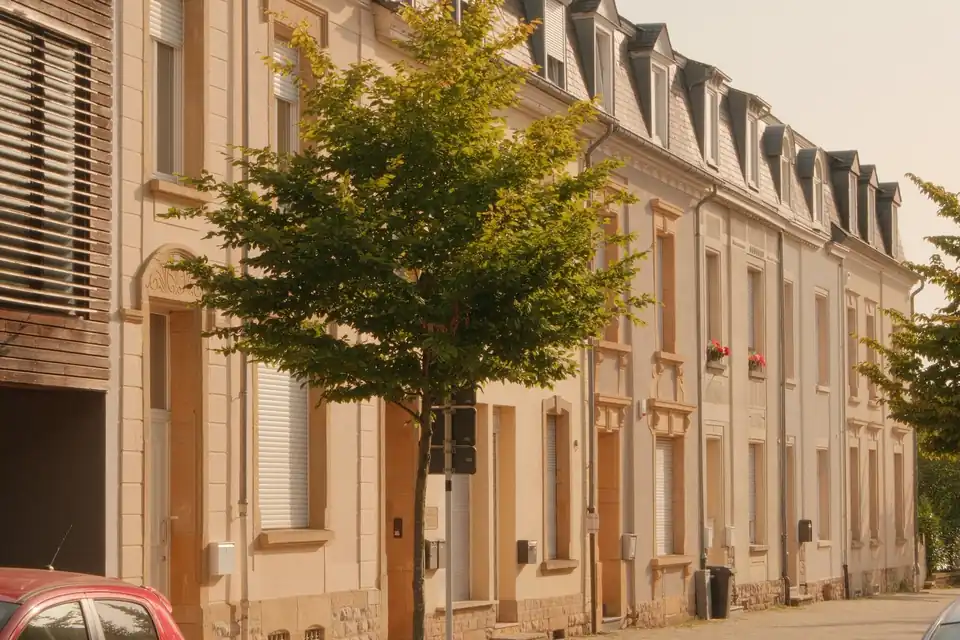
In Luxembourg City, houses are concentrated in a few quarters, mostly residential and relatively low-rise:
- Belair and Merl, west of the centre, with townhouses and detached homes on quiet streets, at the top of the city's price range;
- Limpertsberg, with older townhouses between apartment buildings;
- Cessange, south-west, quieter and more suburban;
- Hamm and Cents, in the east, with streets of family houses and a village feel in places.
In the central quarters, Ville Haute, Gare, Kirchberg or Gasperich, the stock is overwhelmingly apartments. For many buyers who want a house with a garden, the real choice is between an apartment in the city and a house in a surrounding commune. Our guide to living in the city or across the border covers the wider trade-off.
Land is the real price difference
What makes houses so expensive in Luxembourg is not the building but the land. A house sits on its own plot; an apartment's share of the land is divided between all the lots in the building. In a country where building land is scarce and sold in small numbers, this is the single biggest reason a house costs so much more than a flat of the same living area.
It also explains why houses have historically held their value well: when you buy a house, a large part of what you pay for is land, which does not wear out. The building, on the other hand, ages, and that is where the next question comes in.
Co-ownership versus sole responsibility
The apartment: shared costs, shared decisions
An apartment is part of a co-ownership (copropriété). You pay monthly charges for the common parts, cleaning, lift, heating in some buildings, insurance and the syndic, and you contribute to the mandatory works fund. Big decisions, a new roof, facade insulation, a lift replacement, are voted by the general assembly.
The advantage is that costs are shared and managed. The disadvantage is that you do not control them: a building that has postponed works for years can present you with a large bill soon after you buy. Our guide to buying in a co-ownership explains which documents to read before signing.
The house: freedom, and every bill
A house has no syndic and no monthly charges. You decide what to repair, when, and with whom. But every roof, every facade, every boiler and every drain is yours alone. Owners of houses need to keep a maintenance reserve of their own, because nobody else will.
A practical test: ask the seller of a house for the dates of the last roof work, facade work and heating replacement, with invoices. For an apartment, ask for the minutes of the last three general assemblies. In both cases, you are looking for the same thing: what will need paying for in the next ten years.
Energy and running costs
A detached or semi-detached house has more exterior walls, a roof and a floor in contact with the ground or a cellar. An apartment in the middle of a building shares walls with its neighbours. For the same living area and the same level of insulation, a house therefore tends to need more heating.
That is why the energy class matters so much for houses, particularly older ones. It shows up in heating bills, in the cost of future renovation, and increasingly in how banks value the property. Read our guide to the energy performance certificate, and if you are considering an older house, our guide to renovating with Klimabonus support.
Daily life and commuting
The practical questions are often more decisive than the financial ones:
- Transport. Most apartments in the city are close to the tram or a frequent bus line. Houses in the outer quarters and communes are usually well served by bus, but a car becomes more useful, and parking becomes part of the budget.
- Space and outdoor life. A garden is the main reason people buy a house. Apartments with a terrace or large balcony are the closest compromise.
- Stairs and lifts. Many townhouses are narrow and tall, with several floors. That suits some households and not others.
- Time. A house takes weekends: garden, gutters, snow on the pavement in winter. Some owners enjoy that; others discover they do not.
Resale and flexibility
Apartments sell in greater numbers, so they are generally easier to price, because there are more comparable sales, and easier to finance for the next buyer. Houses are sold less often and are more individual, which can make both pricing and selling take longer. On the other hand, a well-located house is a scarce product, and scarcity supports value.
If you expect to move again within a few years, liquidity counts for more. If you are buying the home you plan to stay in, it counts for less. Our guide to how a property is valued explains how comparable sales determine price for both.
A simple decision grid
| If you… | Consider |
|---|---|
| work in the centre and want to walk or take the tram | An apartment |
| want a garden and can accept a car or longer commute | A house, likely outside the centre |
| have little cash reserve after the purchase | An apartment in a well-managed building |
| want full control over works and costs | A house |
| may move within a few years | An apartment |
Our take
In Luxembourg, the house-or-apartment question is rarely decided by preference alone. Budget and location usually settle it: a house in the city's residential quarters costs, on the official figures, well over a million euros in the Luxembourg canton, while an apartment gives access to the centre at a fraction of that. What we see most often is buyers underestimating the running side: co-ownership works for flats, maintenance and energy for houses. Whichever you choose, ask for the history of the building before you sign. Browse our current listings or read the neighbourhood guides to see what each quarter offers.
Sources
- Le Logement en chiffres N°19, March 2026, STATEC and Housing Observatory
- Prix de vente par commune, Housing Observatory
- Au 2e trimestre 2026, retour à la normale sur le marché immobilier, L'essentiel
- Les cinq chiffres du logement au 2e trimestre 2026, Paperjam
- Le marché immobilier résidentiel au 1er trimestre 2026, Housing Ministry
This article describes general rules and market practice in Luxembourg and is not legal, tax or financial advice. Rules and announced measures change; confirm the position that applies to you with a notary, your bank or a tax adviser before signing.