In this article
- The Pétrusse valley: a park through the middle of the city
- The Municipal Park and the Kinnekswiss
- Parc de Merl: the west's family park
- Kirchberg's three parks
- The Bambësch and the Grünewald: forest inside the city
- Parc Ban de Gasperich: green space in the newest district
- Smaller parks worth knowing
- Which quarters are greenest
- Our take
The Pétrusse valley: a park through the middle of the city
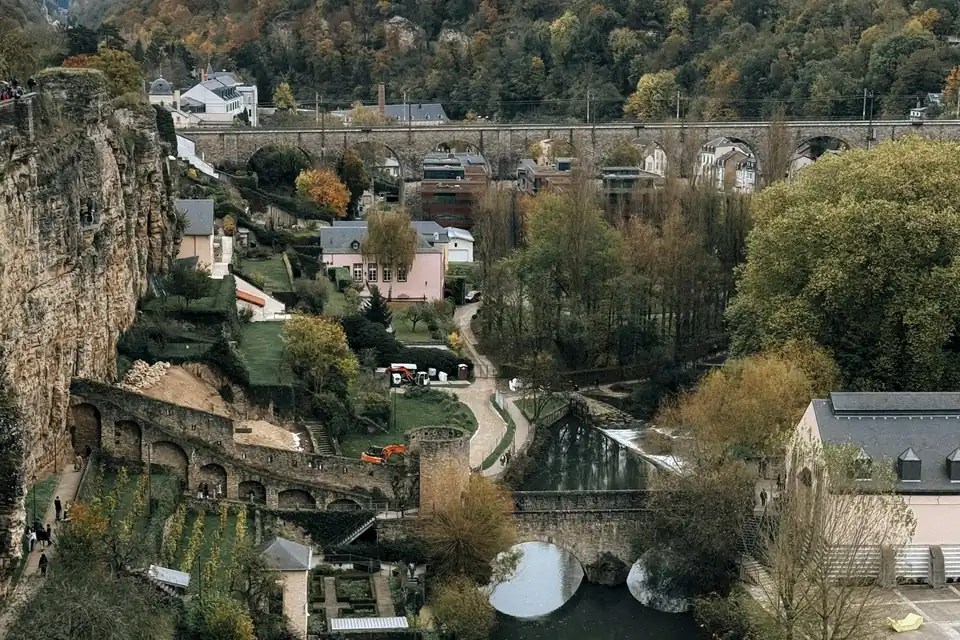
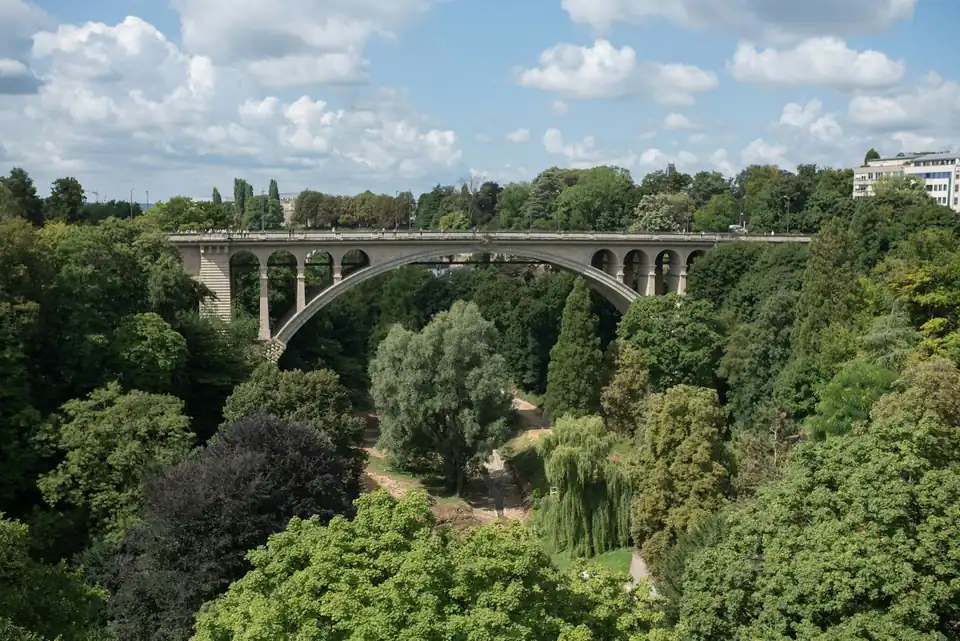
The Pétrusse valley cuts through the heart of the capital below the old town, its steep sides, rock formations and the remains of the fortress bastions giving it a romantic, almost wild character for a space so close to the centre. According to Visit Luxembourg, its parks form part of a network that includes the Kirchberg parks, the Parc de Merl-Belair and the Parc Tony Neuman in Limpertsberg. Footpaths run along the valley floor and up its slopes, connecting the Gare quarter, Ville Haute and the Grund. The valley has also been the focus of ecological redevelopment work by the City in recent years. It sits within walking distance of Ville Haute, the Gare quarter and the Grund, and our guide to the old town covers how residents there use it.
The Municipal Park and the Kinnekswiss
North and west of the old town, the Édouard André Municipal Park covers 19 hectares in a green belt around Ville Haute, designed by the French architect Édouard André after the 1867 Treaty of London ordered the dismantling of the fortress. Its main open space, the Kinnekswiss ("king's meadow"), is the largest clearing in the park and a popular gathering point, hosting an annual open-air music festival each July. The park is also home to Villa Vauban, an art museum, and, as of a 2022 count, 1,299 trees, mostly maple, linden and oak. It borders Limpertsberg to the north and Ville Haute to the south, making both quarters exceptionally green for their central position. See our guides to Limpertsberg and the old town.
Parc de Merl: the west's family park
The Parc de Merl, on the border between Merl, Belair and Hollerich, is the go-to green space for families in the western quarters, with a pond, lawns, a playground and paths used daily. It is one of the reasons families weighing Belair against Merl often end up choosing based on which side of the park they prefer rather than the quarter name itself. Our guide to Merl and Cessange describes daily life around it.
Kirchberg's three parks
Kirchberg, built from farmland into the country's business district from the 1960s onwards, was given a deliberate landscape plan alongside its offices. According to the Fonds Kirchberg, the plateau now holds three public parks covering roughly 30 hectares in total, with around 500 plant species introduced since 1994:
- Parc Central, designed by the German landscape architect Peter Latz and completed around 1999 to 2000, with meadows, a playground, a boules pitch, a café, an artificial mound offering views, and a lake that doubles as a retention basin.
- Parc Réimerwee, an arboretum continuing south from Parc Central to Avenue John F. Kennedy, popular with joggers and office workers, with sculptural stelae by the artist Ulrich Rückriem.
- Parc Klosegrënnchen, built in 1997 from excavation material left over from road works, with artificial sand dunes hosting rare plants adapted to poor soil, spiral-shaped retention basins and damp meadows with ponds.
For residents of Kirchberg's newer developments, these parks are a genuine daily asset rather than an afterthought, and our guide to living in Kirchberg covers the quarter more broadly.
The Bambësch and the Grünewald: forest inside the city
At the upper end of the Rollingergrund valley, the Bambësch forest offers a 2.7 km exercise trail with 18 stations and a 5.5 km cross-country running route, the Crosslaf, both starting near the Bambësch sports centre, according to the City of Luxembourg, along with a large forest playground. It is reached by bus and is the main green asset for Rollingergrund and neighbouring Mühlenbach. Further north and east, the Grünewald forest runs along the edge of Kirchberg and Dommeldange, giving both quarters direct access to woodland despite one being a business district and the other a former industrial valley. Our guides to Rollingergrund and Mühlenbach and the northern valley quarters describe how residents use them.
Parc Ban de Gasperich: green space in the newest district
In the Ban de Gasperich district, built alongside the Cloche d'Or business and retail area, a new park anchors the neighbourhood's residential streets, described by the City as intended to function as a green centre for the district as it is completed. It reflects a broader pattern in Luxembourg's newest developments: green space planned in from the start rather than added afterwards. Our guide to Gasperich and Cloche d'Or covers the wider district.
Smaller parks worth knowing
Not every green space is a destination in itself, but several make a real difference to daily life in their quarter:
- Parc Tony Neuman, in Limpertsberg, a smaller neighbourhood park popular with local families.
- The Mansfeld park in Clausen, on the site of a sixteenth-century Renaissance palace, now a quiet spot along the Alzette.
- River paths along the Alzette through the Grund, Clausen, Pfaffenthal and Pulvermühl, popular with walkers, runners and cyclists, and used by kayakers on some stretches.
- The park near the historic Collart castle in Dommeldange.
Which quarters are greenest
If daily access to genuine green space is a priority, the quarters that combine a major park with a residential setting are Limpertsberg (Municipal Park and Kinnekswiss), Belair and Merl (Parc de Merl), Kirchberg (its three plateau parks and the Grünewald), and Rollingergrund (the Bambësch). The valley quarters, the Grund, Clausen and Pfaffenthal, offer river paths and dramatic natural surroundings rather than a formal park, which suits residents differently: less lawn, more landscape. Our guide to the valley quarters explains that trade-off in more detail.
Our take
Green space in Luxembourg City is not evenly spread, and it is worth choosing a quarter partly on which kind of green space suits your life: a formal park with a playground for young children, a forest trail for running, or a valley path for a quieter walk. When we show a property, we point out which of these is genuinely a five-minute walk away, not just visible on a map. See our neighbourhood guides for more on each quarter, or contact us to talk through what matters most to you.